 SURIQ
SURIQYour database, watched like a DBA would.
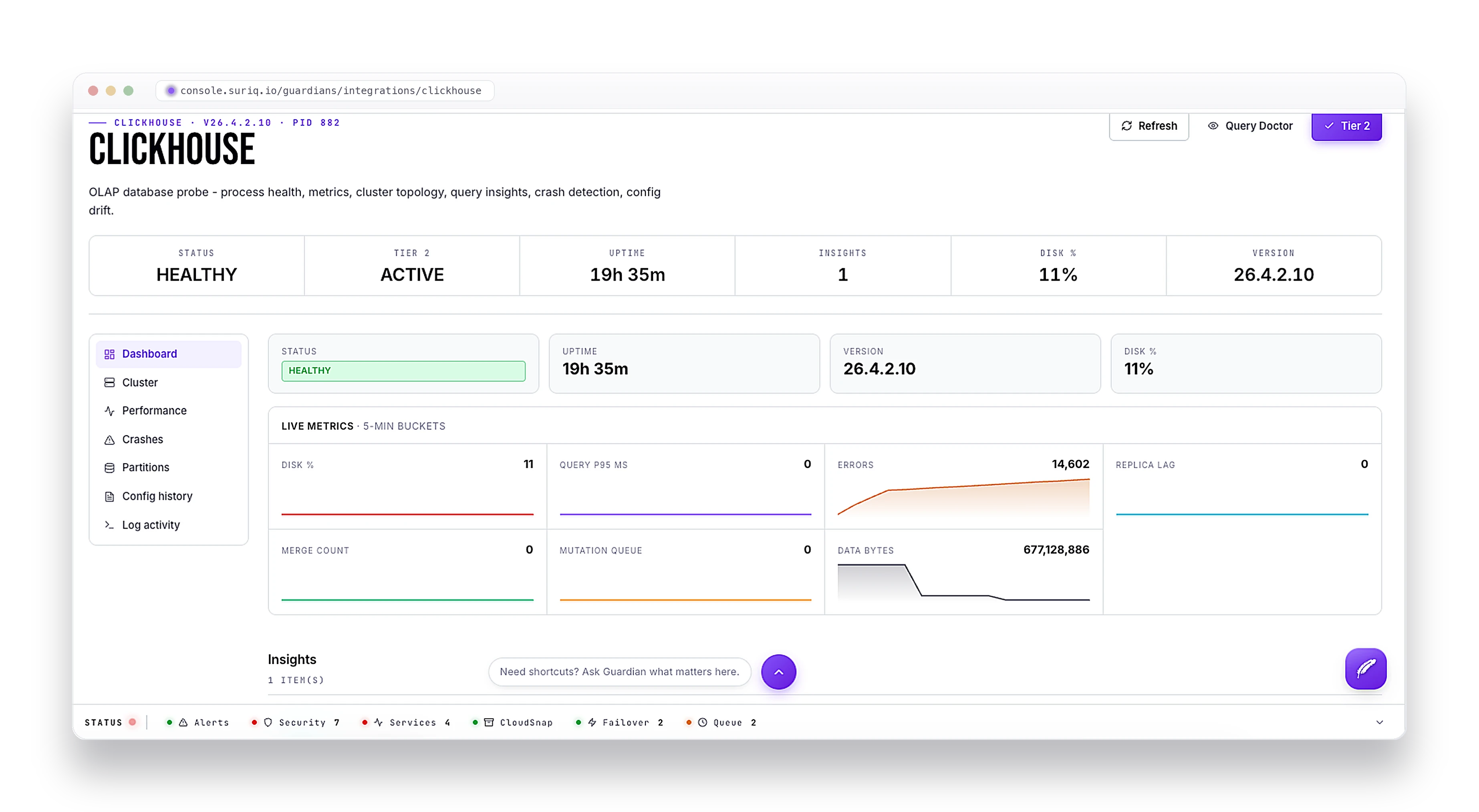
Suriq probes your ClickHouse and turns it into a live health view - process and disk, running queries, cluster replicas, crashes, and config drift - right next to the alerts for the same server. No new dashboards to babysit.
It reads the database - and tells you what is actually going on.
ClickHouse comes in two tiers. The first lights up the moment a Guardian lands on the host, with no database credentials at all. The second is opt-in: connect a read-only probe user and Suriq starts reading the engine's own system tables for query-level insight.
- Live process health - up or down, uptime, memory, and CPU for the server
- How full the data disk is, and the size your tables are taking up
- Which ports are listening, and a warning when one is open to the internet
- Crashes and fatal errors pulled straight from the server log, in plain language
- Config drift on config.xml, users.xml, and the drop-in fragments - so an out-of-band edit never slips by, with users.xml changes treated as high severity
- Live metrics in 5-minute buckets - disk, query p95, errors, replica lag, merges, mutation queue, and data size
- The queries running right now, with the ability to cancel a runaway one
- Your slowest query patterns, with an AI Query Doctor that returns concrete fixes - not vague advice
- Cluster topology across shards and replicas, and a flag when one replica's config has drifted from its peers
- A crash post-mortem that reconstructs the timeline, names the likely cause, and suggests next steps
- Your biggest partitions by storage, with a "what if I dropped this" estimate before you run it
- A capacity forecast that warns when disk or the mutation queue is heading toward trouble
- A security read on your database users and grants, and a flag when the default user has no password and is not locked to localhost
- Kill a runaway query or a stuck mutation in one click
- Reload config or flush logs without restarting the server
- Optimize a partition or sync a lagging replica when it needs a nudge
- Reclaim disk by pruning ClickHouse's own log tables when a box is running tight
- Every action gated by role, logged, and high-risk ones held behind a type-to-confirm
Tier one reads what the server already exposes - the process, the data directory, listening sockets, the config files, and the server log - so it works on any ClickHouse host with nothing to install. Tier two adds a read-only probe user that reads the engine's system tables for the deep view, with credentials kept in the vault. The AI features - the Query Doctor, the crash post-mortem, and the drop-partition estimate - are advisory: they hand you the DDL to copy, they never run it for you.
Frequently asked questions
What does the Suriq ClickHouse integration do?
Does it work without database credentials?
What deep metrics does the ClickHouse integration show?
Can it warn me before ClickHouse runs out of disk?
Does the AI change my database for me?
Stop SSH-ing in to check on your database.
Deploy a Guardian and ClickHouse shows up in the console - read live, tied to your incidents, and ready to act on.