 SURIQ
SURIQKnow which hosts a CVE hits, without a scan.
A CVE drops, and the only question that matters is which of your servers are actually exposed. Suriq checks every host's installed packages against the CVE databases continuously, scores each finding by CVSS, and groups them by family - so the moment something lands, you see exactly where you are exposed and what to fix first.
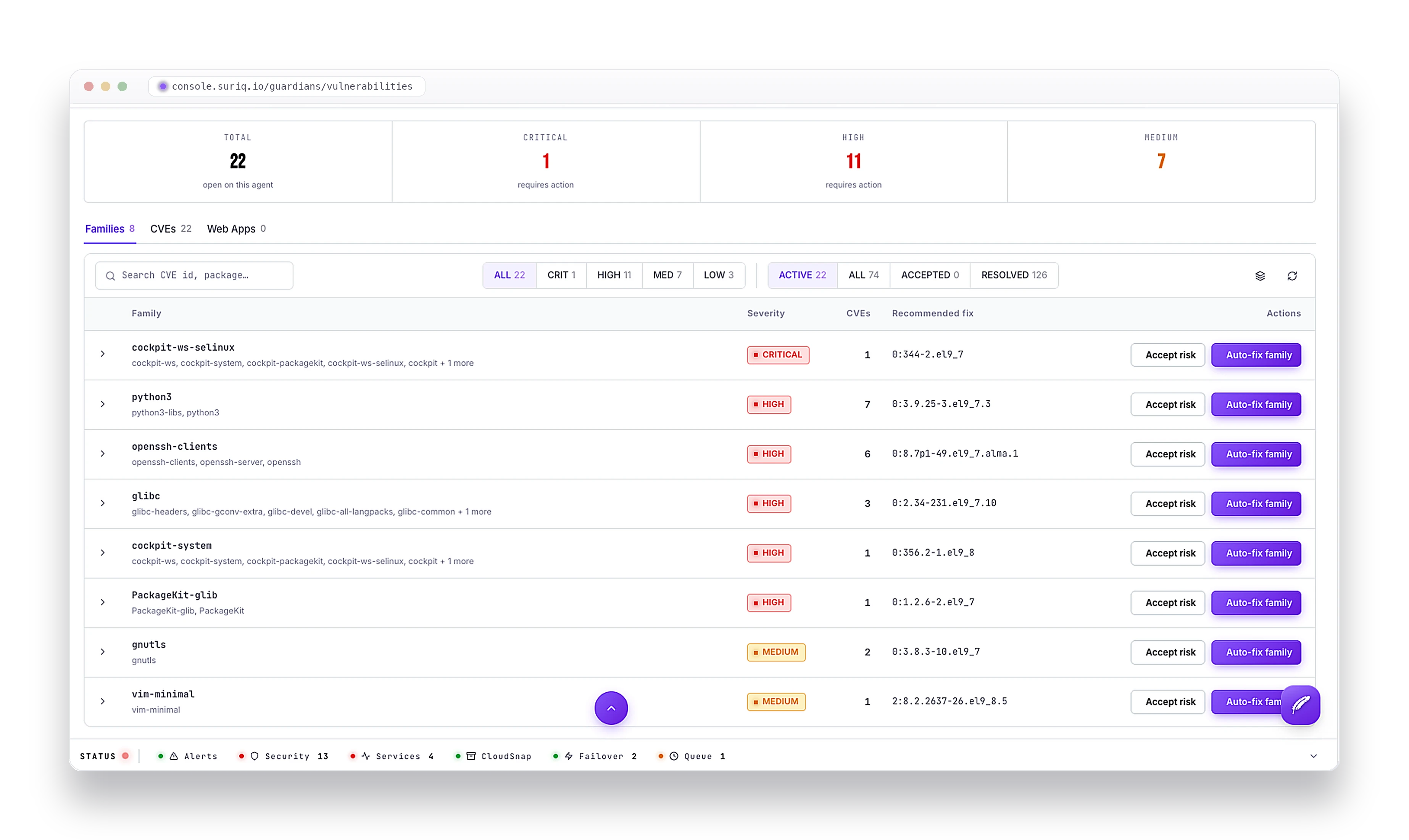
A CVE drops. Now find every host it touches - by hand.
The advisory hits the news, and the scramble starts: which servers run the affected package, at which version, and which of those are actually reachable? Done by hand across a fleet, that answer takes days. The exposure is open the whole time.
Continuous CVE scanning
Every host's installed packages are checked against the CVE databases on a managed Wazuh core, each finding scored by CVSS and grouped into families so the picture stays current, not quarterly.
Exposure without a scan
When a new CVE lands, see exactly which hosts run the affected package, ranked by severity - so your team patches the real exposure first, not a spreadsheet of maybes.
A fix, explained
The built-in assistant turns the CVE into a plain-English read and suggests the remediation. It advises; your team approves and acts. Guided and approval-gated, never a silent auto-patch.
Legacy stack vs. Suriq
| Dimension | Legacy | Suriq |
|---|---|---|
| Scan cadence | Manual or quarterly scans | Automatic, on a regular schedule |
| Exposure mapping | Manual cross-reference | Which hosts, in seconds |
| Prioritization | A CVSS dump | Ranked worst-first |
| Remediation | You research it | AI-explained, guided, approval-gated |
Catch the misconfigurations attackers look for.
Every host scored continuously against security-hardening baselines, the risky settings ranked first, with guided, approval-gated fixes.
Know who is exposed, fast.
When a new CVE drops, Suriq tells you which hosts it hits - then correlates, alerts, and keeps a full audit trail through the recovery.
Frequently asked questions
How does Suriq find which hosts a new CVE affects?
How does Suriq prioritize which vulnerabilities to fix first?
Does Suriq patch vulnerabilities automatically?
Is Suriq an alternative to Tenable or Qualys vulnerability scanning?
Do I need to install an agent for vulnerability detection?
See what Suriq finds on your own servers.
Agentless checks for uptime and your cloud, a lightweight agent for detection on each server, and one console that ranks and explains what it finds.