 SURIQ
SURIQ01
Secrets live in a vault, not our database
Every credential sits in the vault. The database, the job logs, and the backups only ever hold a reference to it - never the value itself.
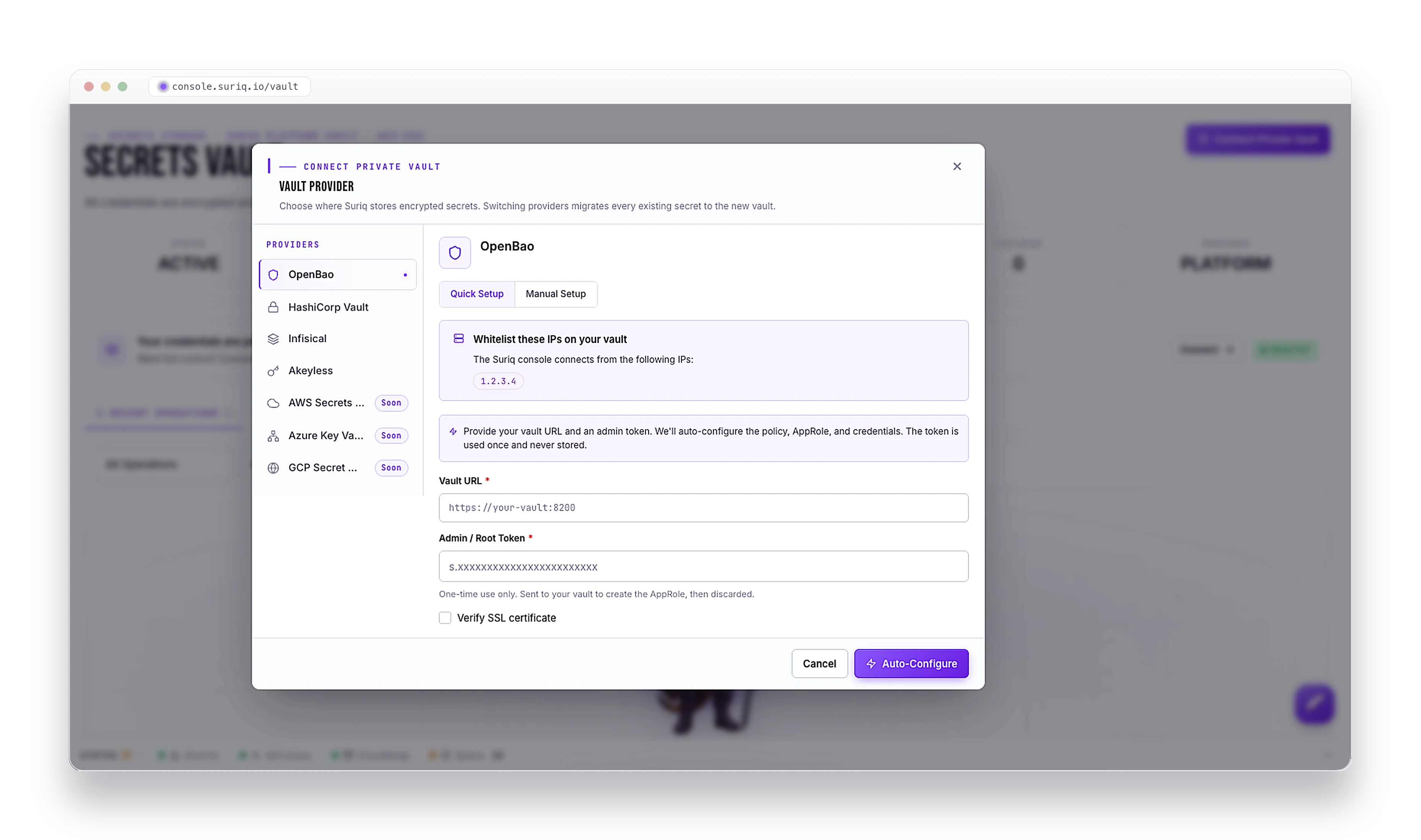
Every API key, token, and password Suriq needs lives in a vault you control - OpenBao, HashiCorp Vault, Infisical, or Akeyless. The console can write a secret but never read it back. Only the job that needs it, at the moment it runs, can.
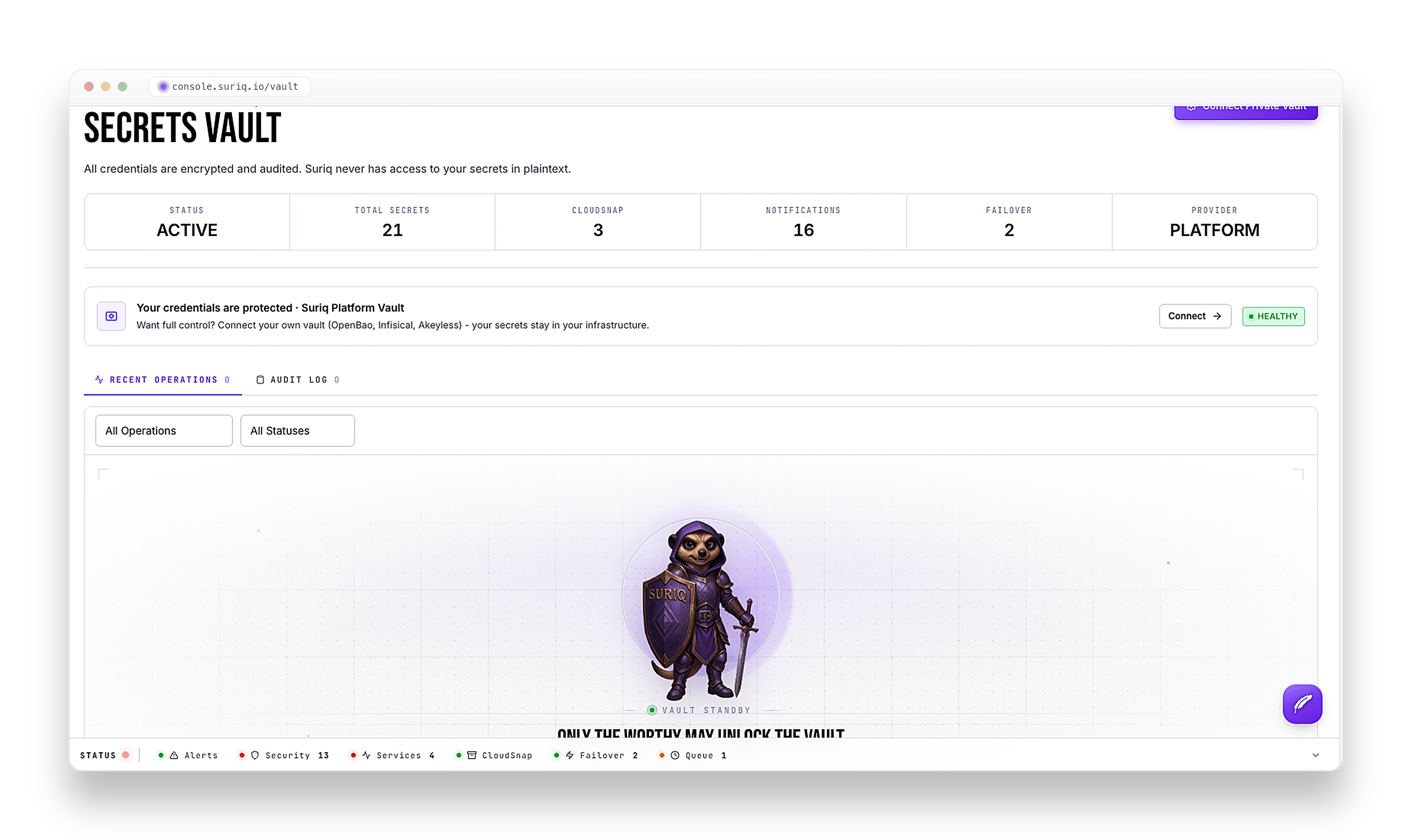
Every credential sits in the vault. The database, the job logs, and the backups only ever hold a reference to it - never the value itself.
One identity writes and deletes secrets. A separate, read-only identity reads them at execution. Neither can do the other's job - so a compromise on one side cannot pull your keys.
OpenBao, HashiCorp Vault, Infisical, or Akeyless - per team, with isolated paths. Or start on the platform's default OpenBao. Same console either way.
On setup, Suriq writes a throwaway probe secret, reads it back, and deletes it. If the permissions are wrong, it fails loudly - before a single real credential is saved.
Change a credential in the vault and Suriq picks up the new value on the next job. No schema change, no restart, no redeploy.
Switch from one vault provider to another and Suriq migrates your secrets across for you, path for path.
You paste a key into the console. Its write identity stores it at a team-scoped path in the vault. The database keeps only the reference.
When a job is created, its record holds the entity ID and the vault path - never the credential value.
The read-only identity fetches the secret at execution, uses it for the one provider call, and holds it in memory only, briefly.
Your vault records the read in its own audit trail - an independent record of who reached what, kept on a system you control.
Every connector follows the same write-only and read-only contract, so the security posture is identical whichever you pick.
Every team starts on the platform's default OpenBao - autopilot configures the engine, policies, and paths for you. Connect your own vault per team whenever you prefer; the console works the same either way.
Vault integration ships with Suriq. Connect the vault your security team already approved, or stand up OpenBao with autopilot in minutes.