 SURIQ
SURIQIncident response, with context in hand.
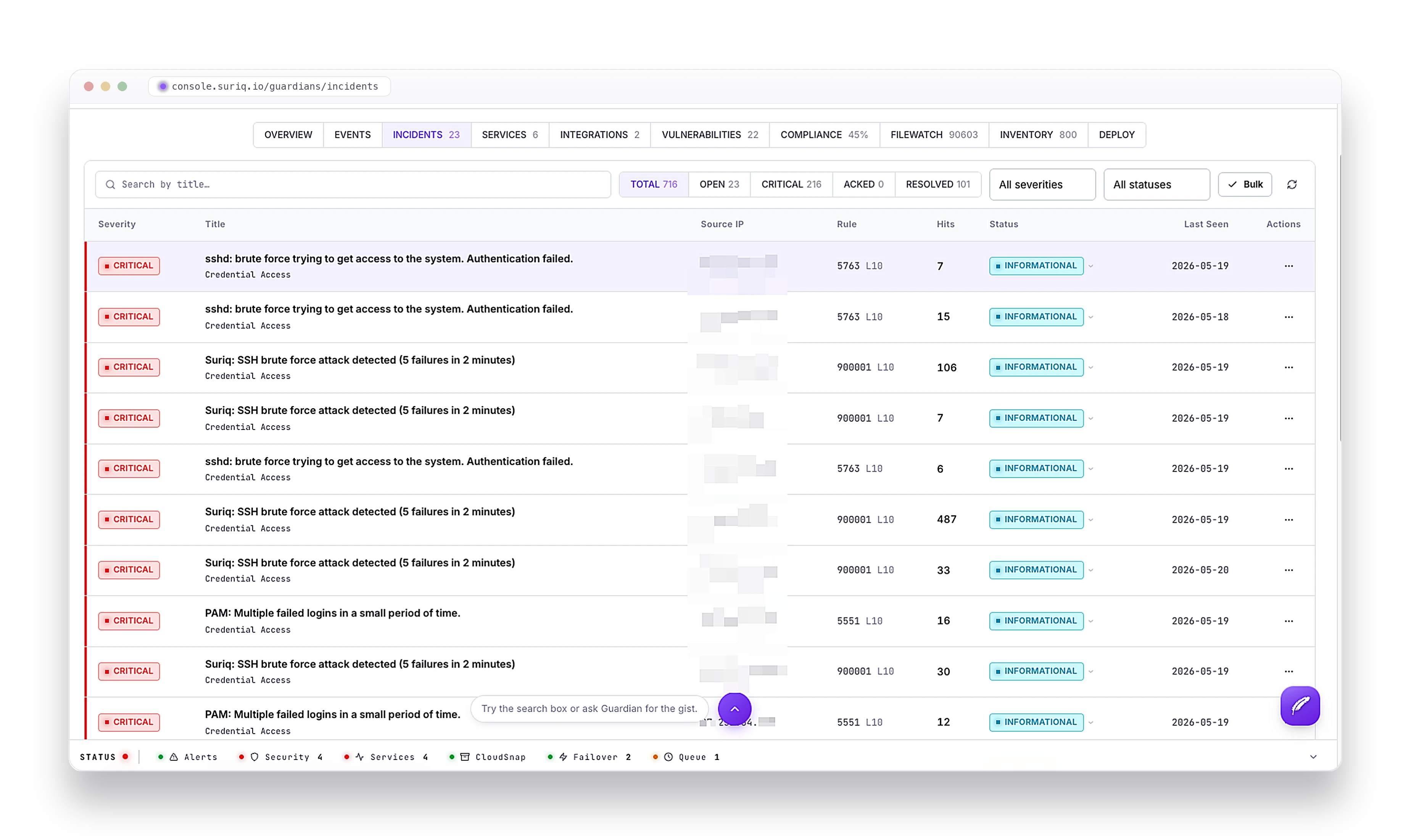
When something actually goes wrong - a breach, a breakage - incident response is the scramble to understand it and shut it down. The old way: detect, page someone, dig through raw logs at 2am, write the timeline by hand. Suriq detects fast on a managed Wazuh core, packs the noise into one clear incident, routes it to on-call, and hands your responder the evidence - with a plain-English read from Guardian a question away.
Attackers hide for months. Then the cleanup takes days you don't have.
Intruders routinely go unnoticed for months. And once you finally declare an incident, piecing it together and shutting it down can take days - days in which they already have everything they came for.
It arrives already understood
Wazuh detections are bundled into one incident, deduplicated, and tagged to the MITRE ATT&CK playbook - then routed to on-call so the right person sees it first, not fortieth.
A plain-English read, instantly
The built-in assistant turns the raw detections into a clear story: what happened, why it fired, what to check next. It advises; your team decides and acts.
Back online, on the record
A clean CloudSnap snapshot is always waiting as the point to recover from, and every action lands on one timeline the instant it happens - so your post-mortem writes itself instead of being pieced together by hand at dawn.
Legacy stack vs. Suriq
| Dimension | Legacy | Suriq |
|---|---|---|
| Time to context | Hours of triage | Correlated incident on arrival |
| Alert routing | Manual triage queue | Deduplicated, routed to on-call |
| Recovery | Manual runbook | A clean restore point already waiting |
| Post-mortem | Reconstruct by hand | Timeline + evidence retained for your post-mortem |
The SOC with the noise cut out.
Your analysts did not go to school to close tickets. Suriq groups and deduplicates alerts, speeds triage with plain-English explanations, and routes what matters to your team.
XDR, without the dashboard tax.
Most "XDR" is a pile of acquired tools sharing a login. Suriq correlates your machines, network, cloud, and logs on one timeline, all detected by Wazuh.
Orchestration, without the playbook rot.
Security response built into the managed SIEM - detections correlated, MITRE-tagged, routed, and explained, with guided response. No playbooks to write or maintain.
Frequently asked questions
How does Suriq turn alerts into an incident?
Where do incident alerts get routed?
Does Suriq automatically fix or contain incidents?
How does Suriq help me recover?
Is there an audit trail of the response?
See what Suriq finds on your own servers.
Agentless checks for uptime and your cloud, a lightweight agent for detection on each server, and one console that ranks and explains what it finds.