 SURIQ
SURIQCatch the misconfigurations attackers look for.
Most breaches do not start with a clever exploit. They start with a setting left wrong - a weak SSH config, a service exposed, a permission too broad. Suriq checks every host against security-hardening baselines continuously, scores each check pass or fail, and hands your team the risky ones first with a guided way to close them.
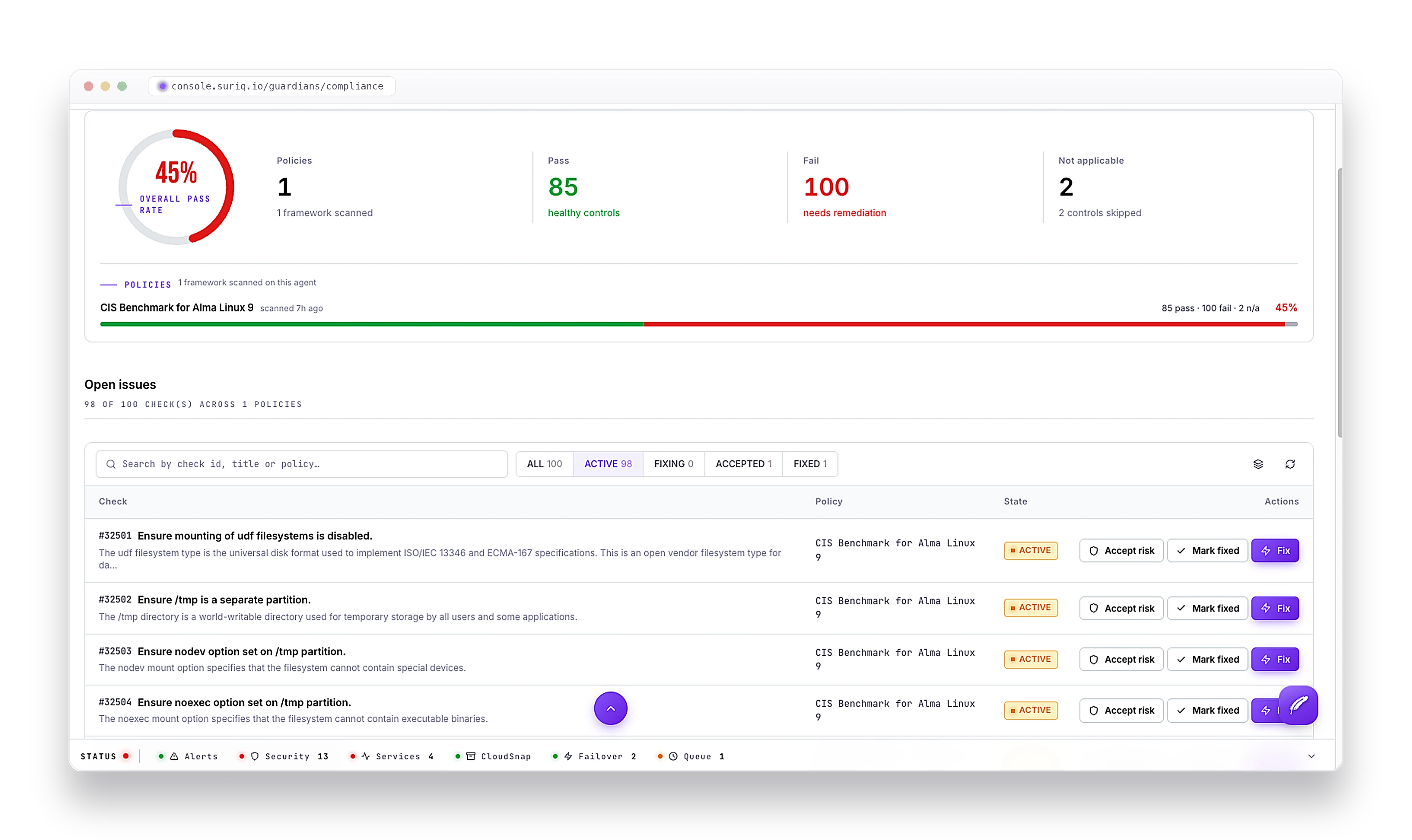
One setting left wrong is all it takes.
Hardening is the work nobody finishes. A baseline gets applied at build time, then drifts - a debug flag here, a loosened permission there - and a point-in-time audit only catches it months later, if at all. Attackers are looking for exactly that gap.
Scored against hardening baselines
Every host is checked continuously against security-hardening baselines on the managed Wazuh core, with a clear pass or fail per check across your whole fleet.
Risky settings, ranked
Suriq surfaces the checks that actually matter and ranks them, so your team fixes the dangerous misconfigurations first instead of wading through a flat checklist.
Guided remediation
The built-in assistant explains each finding and the change it needs in plain English. Remediation is guided and approval-gated - your team decides and acts, every move on the audit trail.
Legacy stack vs. Suriq
| Dimension | Legacy | Suriq |
|---|---|---|
| Cadence | Point-in-time audit | Continuous |
| Output | A flat checklist | Ranked findings |
| Fix | Do it yourself | Guided, approval-gated |
Know which hosts a CVE hits, without a scan.
Continuous package scanning against the CVE databases, scored by CVSS and ranked worst-first, with a fix Jack can explain.
Know the instant a critical file changes.
Watches the files that matter for every change, tags the suspicious ones to MITRE ATT&CK, and lets you baseline out the noise.
Frequently asked questions
What is security hardening?
How does Suriq score hosts against hardening baselines?
Does Suriq fix misconfigurations automatically?
How is this different from a point-in-time hardening audit or CIS scanner?
See what Suriq finds on your own servers.
Agentless checks for uptime and your cloud, a lightweight agent for detection on each server, and one console that ranks and explains what it finds.